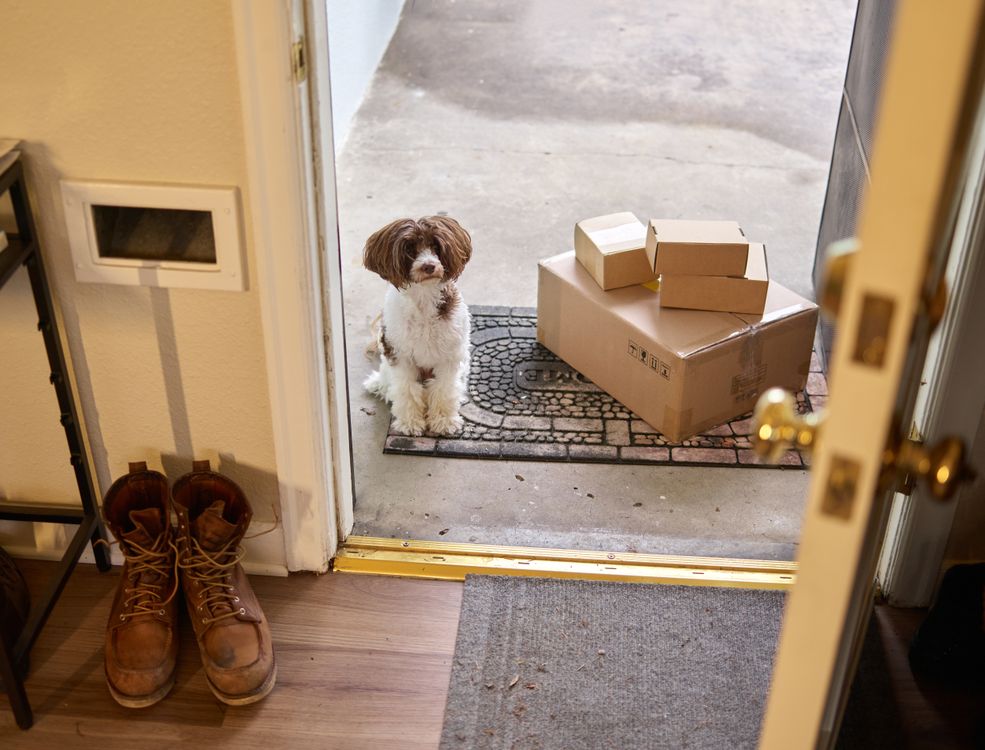
The box hits the doormat and my dog knows before I do. She stands over it, tail going, nose working the cardboard flap, and for about four days she carries the new plush squirrel everywhere. Then it goes behind the couch with the other squirrel. Three weeks later another box arrives and we do the whole thing again, which is either money well spent or a slow leak in the household budget.
What actually comes in one
Most dog subscription boxes follow the same recipe: two toys, two bags of treats, and a chew. Vetstreet unpacked one on a kitchen counter and photographed the contents, and their breakdown puts the classic tier at roughly $22 to $35 per box and the heavy-chewer tier at $26 to $39, with the price per box dropping when you commit to a longer plan. One honest note: that review is a sponsored collaboration, so skim the enthusiasm and take the pricing.
Bought piece by piece at a pet store, the same haul rarely comes in cheaper. A rubber toy that survives more than a week runs $10 to $15, two bags of treats can hit $20, and a decent long-lasting chew is $5 to $10. Pet stores put the impulse bin next to the register for a reason.

The thing you are really paying for is newness
Why does a fresh box land so well? Not because of the toy itself. Researchers at the University of Giessen in Germany and the University of Lincoln in England studied Labrador retrievers and found the dogs were interested in each new toy and then lost interest once it became familiar. The American Kennel Club notes that owners spend about $79 a year on new toys for the same reason. What a subscription sells is newness on a schedule.
Newness is also the cheapest part to manufacture yourself.
How to get the same effect for free
Rotation. Keep four or five toys on the floor and everything else in a bin in a closet. Every week or two, trade the floor for the bin. A tug rope that has been out of sight for ten days comes back as a brand new toy, and your dog cannot tell the difference between that and a cardboard mailer on the porch.
The other half of a good box is the food puzzle, and that is cheap too. Soak part of the daily kibble, pack it into a rubber toy, and freeze it. A frozen stuffed toy buys you twenty quiet minutes and costs nothing beyond food you were going to feed anyway. Same for a towel with kibble rolled into it, or a cardboard box to shred under supervision.

Four questions before you subscribe
- Does your dog play alone? Some dogs only care about a toy while a human is holding the other end. The AKC notes dogs prefer toys that involve you, so a box will not fix a dog who wants company instead of objects.
- How fast does your dog wreck a plush toy? Hours, and you want the heavy-chewer tier plus the replacement guarantee. Days or weeks, and the classic box is plenty.
- Would you buy these treats anyway? The treat half is the part people forget, and it quietly wastes money if your dog has allergies or a touchy stomach. Look for a toys-only tier before you write it off.
- Can you pause it? Most services let you skip a month or change plans, so check before you hand over a card.
Three or four yes answers and the subscription is a reasonable buy. Two, try a single toys-only month. One or none, put that money in a rotation bin and spend nothing.
If you do subscribe
- Pick the tier for the dog in front of you, not the dog you wish you had.
- Get the size band right. Boxes size toys and treats by weight, and a toy that is too small for a big chewer is a hazard.
- Set a reminder for three months out to actually look at the plan. These boxes rarely stop being worth it because of the price. They stop being worth it because nobody cancels, and you keep paying while your dog stopped caring somewhere around month six.
What to buy once instead
If the goal is a dog who has something to do, spend once: a durable rubber toy you can stuff and freeze, a puzzle feeder, and a snuffle mat. Call it $60 together, against about $264 for a year of $22 boxes. The rotation does the work in both cases.
One-time gear still has a place. If your fall weekends involve trails, a fitted backpack gives your dog a job and takes some water weight off your shoulders, and our dog backpack training guide covers the fitting part. If a trip is still on the calendar, the road trip packing guide covers what actually earns space in the car, and skipping two months of boxes pays for most of it.
None of this makes subscription boxes a scam. If the arrival is fun for your household, the treats get eaten, and the price is not a stretch, you are paying a fair price for a small monthly event. Just do not credit the box for a happy dog. The newness does the work, and you can run that yourself. My dog has never once asked where the squirrel came from.